


29 Mar Industrial Lighting Standards
Lighting standards in industrial facilities play a critical role in terms of occupational safety, productivity, and energy savings. Therefore, appropriate lighting allows employees to perform their jobs more comfortably and without errors, while also helping to prevent accidents. Furthermore, inadequate or incorrect lighting can lead to eye strain, loss of focus, and production errors, while also hindering the quality and reliability of sensitive production processes in certain sectors (e.g., electronics or pharmaceutical manufacturing). In this context, lighting standards support both employee health and the sustainability of businesses by defining ideal lux levels, glare reduction methods, and energy-efficient solutions for each workspace. In short, compliance with international standards such as S EN 12464-1, OSHA, and ANSI is vital for creating optimal working conditions in industrial facilities.
What should be considered in lighting standards for industrial facilities?
Industrial facilities must adhere to specific lighting standards. Otherwise, it can create safety hazards. Points to consider in this context include:
- Minimum lux levels suitable for the work area should be determined. For example, 500-1000 lux is suitable for production and assembly areas, while 100-300 lux will be sufficient for warehouse and logistics areas.
- Direct and indirect glare should be reduced to protect the eye health of employees. At the same time, the amount of light reflected from surfaces should be controlled, and matte surfaces should be preferred.
- Appropriate diffusers and lenses should be used for LED lights.
- Furthermore, luminaires suitable for the needs of the industrial environment must be used.
- For areas containing chemical or explosive gases: EX-proof (explosion-proof) lighting should be used.
- In addition, for dusty and humid areas: lighting with an IP65 protection class or higher should be preferred.
- The use of LED lighting should be encouraged, and inefficient halogen or mercury vapor lamps should be avoided.
- Unnecessary energy consumption should be prevented with motion sensors, timers, and automatic lighting control systems.
- Moreover, maximum benefit should be obtained from daylight, and natural lighting systems should be used.
- For security cameras to perform optimally, sufficient light levels must be provided.
- Periodic lighting measurements should be taken, and light levels should be checked to ensure they meet standards.
- Light levels reduced due to dirt and wear should be corrected with regular maintenance, and faulty or inefficient lamps should be replaced promptly.
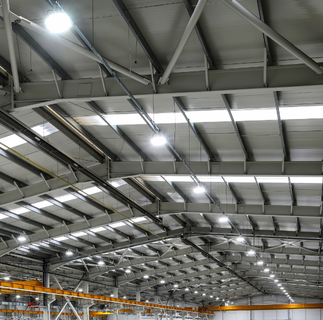
Lighting Standards According to Industrial Facilities
- Factories: Since factories are areas where production processes take place intensively, proper lighting is of great importance for occupational safety and productivity. Lighting at a level of 500-1000 lux should be provided in general production areas. This allows employees to work more comfortably. Furthermore, light sources with a CRI value of 80 and above should be preferred so that employees can see details clearly. In addition, factory lighting should be homogeneous and reduce eye strain for employees.
- Chemical and Petrochemical Plants: Lighting is a critical safety element in chemical and petrochemical plants. Therefore, in these facilities where flammable and explosive materials are present, EX-proof (explosion-proof) LED lighting should be used. This ensures a safe working environment. Furthermore, IP65 or IP67 protection class luminaires should be preferred to provide resistance against chemical vapors and gases. Finally, the lighting level in chemical plants should be between 500-750 lux, creating an environment where operators can safely manage chemical processes.
- Food Processing Plants: Lighting in food processing plants must be specifically planned to both comply with hygiene standards and increase employee productivity. Lighting levels of 500-1000 lux are particularly necessary in production areas. Furthermore, lighting fixtures in production facilities should have enclosed housings, be dustproof and waterproof (IP65), and have protective coatings to prevent the risk of glass breakage. The correct color temperature selection (5000K-6000K) supports quality control of food products.
- Pharmaceutical Manufacturing Facilities: Lighting is crucial in pharmaceutical manufacturing facilities to maintain sterile conditions and perform highly precise processes. Therefore, lighting levels of 500-1000 lux should be provided in production areas, and 750-1500 lux in laboratories. Additionally, the light sources used should have high color accuracy (CRI 90+) and be enclosed, IP65/IP67 protection level luminaires. Furthermore, flicker-free LED systems should be preferred to protect the eye health of workers and provide comfort during long working hours.
- Metalworking and Foundries: Metalworking and foundries require specialized lighting systems due to high temperatures, heavy equipment, and the shiny surfaces of metal parts. In this context, the lighting level should be 750-1200 lux, and high-temperature resistant IP65/IP67 protected LED floodlights should be used. To reduce glare and reflections, matte-coated luminaires that minimize reflection should be preferred. Finally, vibration-resistant lighting equipment should be used to provide resistance against vibrations caused by machine operation.
- Paper and Textile Factories: In paper and textile factories, lighting must be carefully planned to ensure accurate color perception and protect the eye health of workers. In line with this plan, lighting in paper and textile factories should be carefully designed to ensure accurate color perception and protect the eye health of workers. LED luminaires with a high CRI value should be used. In addition, EXproof luminaires should be used in areas with high concentrations of flammable dust and fibers, and regular maintenance should be performed to prevent dust accumulation.
- Recycling Facilities: In areas with high concentrations of flammable dust and fibers, EX-proof luminaires must be used, and regular maintenance must be performed to prevent dust accumulation. Therefore, recycling facilities require a large area for sorting and processing waste, and proper lighting of these areas is crucial. The luminaires are also resistant to environmental factors such as dust and humidity. This ensures efficient lighting even in dusty and humid conditions.
- Warehouses and Storage Facilities: Adequate lighting is essential for safe and efficient product placement in warehouses and storage facilities. Therefore, a lighting level between 100-300 lux is sufficient. Narrow-angle LED linear lights should be used between shelves to direct light directly onto the products. In addition, motion-sensor products should be preferred to optimize energy consumption in warehouse lighting. Thus, correctly positioned LED lights prevent shadowing, enabling operators to work quickly and without errors.
- Cold Storage Facilities: Cold storage lighting systems must withstand low temperatures and be unaffected by temperature fluctuations. Lighting levels should be between 150-300 lux, and motion-sensor lighting is preferred. LED fixtures suitable for temperatures of -30°C and below must operate efficiently and maintain their light level. Fixtures containing glass or fragile materials must have enclosed protective systems due to food safety concerns.
- Research and Development (R&D) Centers: High lighting levels are required in R&D centers for conducting precise measurements and testing processes. Lighting should be between 750-1500 lux in laboratory areas and 500-1000 lux in experimental areas. Flicker-free LED systems with a high CRI (Critical Resistance Ratio) to protect eye health should be preferred. Adjustable light levels provide flexibility for different experimental processes.
Quality in production begins with lighting.
In addition, industrial lighting design should protect the eye health of workers, provide long-term comfort, and enhance workplace safety. Regular maintenance and lighting measurements are important for maintaining compliance with standards. This both prevents workplace accidents and increases production efficiency.

No Comments